“I went out to the hazel wood,
Though I am old with wandering
Through hollow lands and hilly lands,
I will find out where she has gone,
And kiss her lips and take her hands;
And walk among long dappled grass,
And pluck till time and times are done,
The silver apples of the moon,
The golden apples of the sun.”
- William Butler Yeats, "The Song of Wandering Aengus"
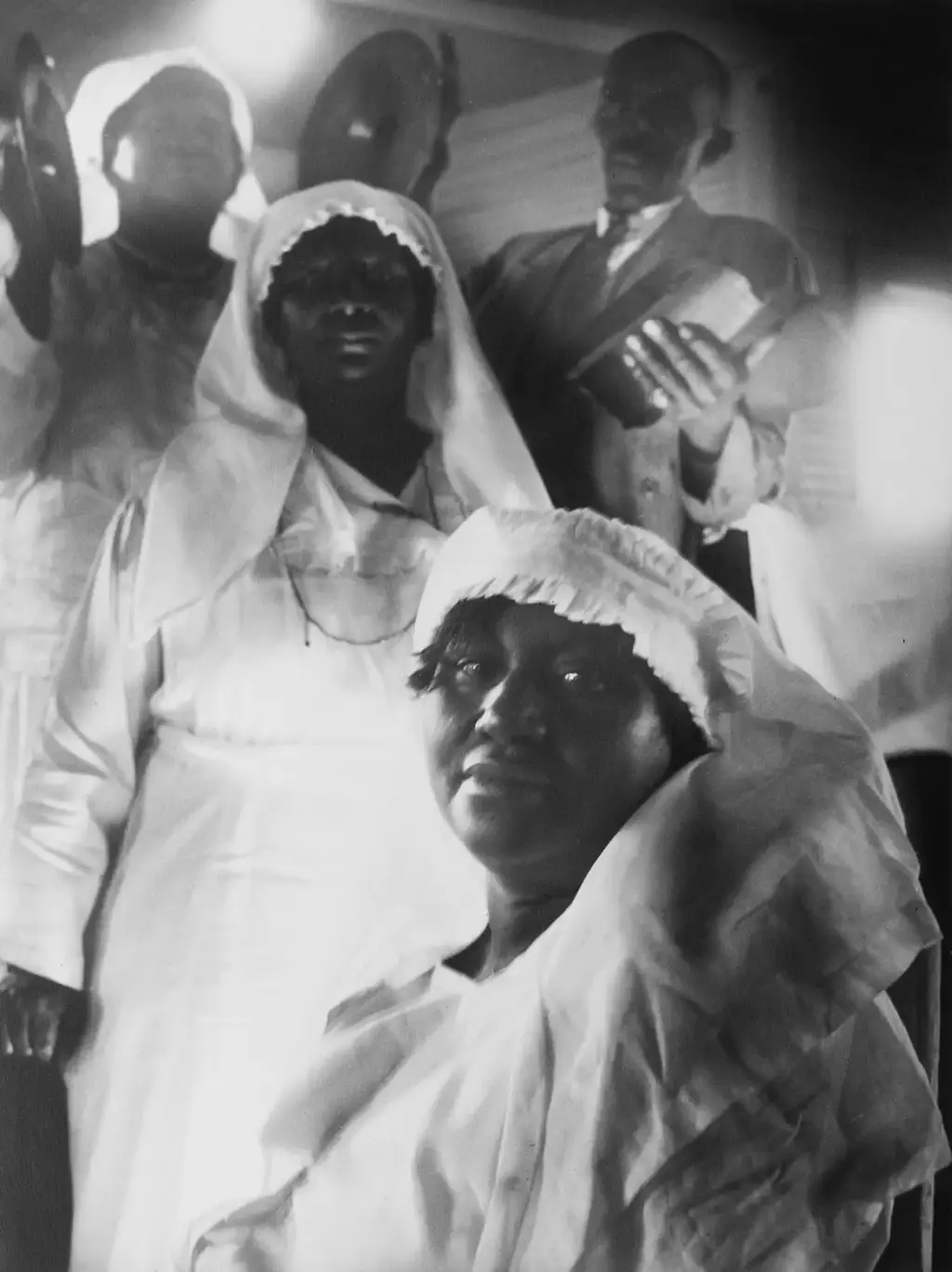
Eudora Welty, "Preachers and Leaders of Holiness Church", 1939
William Butler Yeats’ “The Song of Wandering Aengus” rings with allusions to the Irish myth of Aengus Óg. This mythological figure, understood to be the god of love, dreams, and poetic inspiration, is represented in a 12th-century medieval Irish tale entitled “Aislinge Oengusso” where a man falls into a state of lovesickness for a woman. Later in the story, the woman is found to have the power of transforming from human to swan, in which Aengus goes to find her in her swan state and, too, transforms with her. Yeats portrays a version of this tale in his poem, however, the character of Aengus is presented as an aging, obsessive figure that dedicates his life to seeking out a silver trout, or the woman from the original tale. In essence, Yeats’ poem and the medieval tale explore themes of love and unwavering dedication for what one is in pursuit of. The poem appears in Eudora Welty’s novel The Golden Apples, which is fiction highly inspired by Yeats’ writing and Welty’s experiences as a woman in the Jim Crow South. With such intricately woven intertextuality between these works, one must consider the implication of using a poem like “The Song of Wandering Aengus” on the message Welty attempts to convey in her writing. Welty’s The Golden Apples is a collection of 7 short stories that recount the lives of citizens in the fictional town of Morgana, Mississippi. The enigmatic, small town of Morgana takes on a cultural life of its own through Welty’s writing, becoming the basis for the interconnectivity and social practices of its inhabitants. Not only is the title of the novel reflective of Yeats’ work, but the final stanza of the poem is directly quoted within the collection’s first short story. Encapsulating the sentiment of Yeats’ poem, Welty states, “Like a wave, the gathering past came right up to her. Next time it would be too high. The poetry was all around her, pellucid and lifting from side to side, “Though I am old with wandering / Through hollow lands and hilly lands, / I will find out where she has gone…” Then the wave moved up, towered, and came drowning down over her stuck-up head” (Welty, 37). Poetry is portrayed as being a divine, transcendental presence embedded within the worldly experience of time passing. Though Yeats’ poem remains up to interpretation, Welty herself has provided insight into how his text moves throughout her own stories and the characters that she has created. In an interview now archived by the New York Times, Welty states, “At length too, at [the University of] Wisconsin, I learned the word for the nature of what I had come upon in reading Yeats. Mr. Ricardo Quintana lecturing to his class on Swift and Donne used it in its true meaning and import. The word is passion” (The New York Times). Welty’s interpretation of Yeats’ work is presented as being reflective of what one could only consider to be pure passion. It is understood that moments of uncritical reflection on the past, especially those induced by the arts as is the case in Welty’s excerpt, are the embodiment of pure passion. Passion is, thus, something that ebbs and flows, like the wave analogy, and is something that, similar to Aengus and his search for his love, must be pursued to the fullest extent. Exploring, understanding, and ultimately coping with the past, especially moments of social trauma, for example, are to be approached with this passion and consistent pursuit of the good that both Welty and Yeats allude to. In consideration of this interpretation, both Louise Kennedy’s Trespasses and Sally Rooney’s Normal People embody what it means to approach and engage with memories of the past. The pursuit of hope, freedom, and the good is an act of resistance to the traumas of the past. In Greek myth, the golden apple represents immortality, perhaps signifying by both Yates and Welty that this pursuit of the truth is greater than the irrevocability of hardship and death. Seeking these positive experiences evade the grasp of the negativity that haunts the characters in each respective novel, whether it be the death of a lover, the fear of being an outsider, or attempting to understand your identity in the midst of it all.
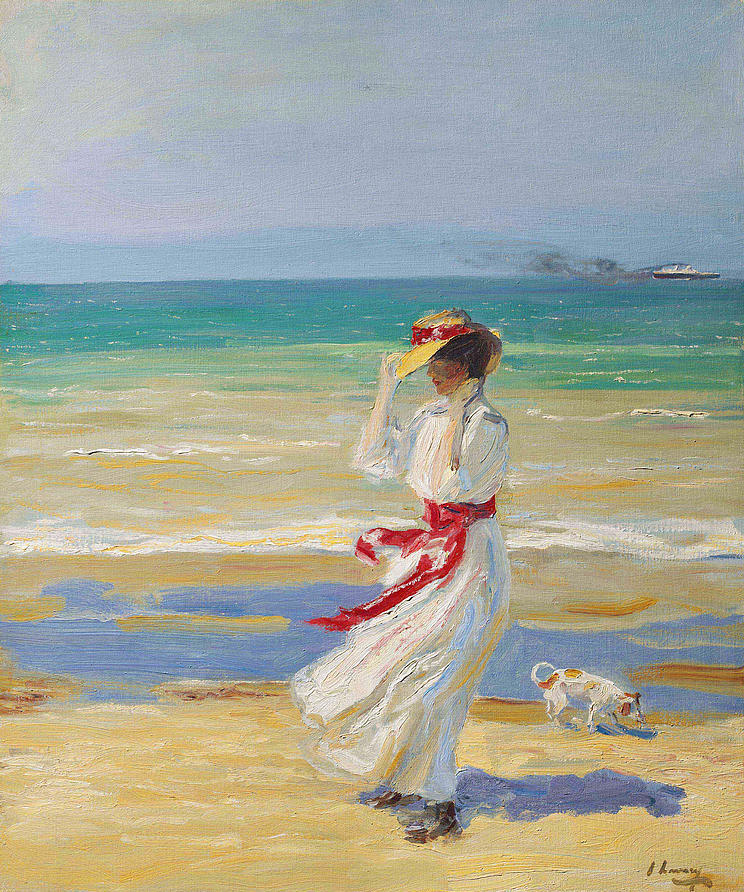
Sir John Lavery, "A Windy Day", 1908
Both the beginning and end of Kennedy’s Trespasses offer a glimpse into the present, while the remainder of the novel is set in the 1970s. The novel focuses on the character of Cushla, a young woman involved in an extramarital affair with an older man during the Irish Troubles. Kennedy carefully crafts the violent subtleties of living in a world centered around exclusion and conflict, which ultimately comes to a head when Cushla’s lover is murdered in an act of political violence. The palpable friction between the past, present, and memory serves as the central point for Kennedy’s work and, furthermore, is mediated through artistic expression. The sculpture of Cushla’s dead lover, entitled “Everyman”, alludes to a “classical composition [that] is a familiar representation of death…hinting at the violence of the subject’s murder” (Kennedy, 2). Envisioning the presence of this sculpture, especially being that it is “splayed awkwardly” with “disordered configuration”, in the reflective space of a museum seems to haunt the scene (Kennedy, 1-2). An image so shockingly displayed commands the viewer to confront these memories of the violent past, which is further emphasized as the museum guide discusses its context to the Troubles. After the reader has engaged with the birth and death of Cushla’s affair, haunted with the image of her lover being murdered, Kennedy presents the audience with a moment of closure through Cushla’s interaction with this statue. In a moment similar to what is explored through Welty and Yeats’ writing, Kennedy states, “The cast is hollow. It conveys a sense of emptiness, as if a body has stepped out of it” (Kennedy, 289). Interpreting these two lines through the context of Kennedy’s overarching message, this artistic piece embodies, at its very core, the purpose of art in coping with the past. The memory of Cushla’s lover is alive in this sculpture, serving as a mediator for accepting and reflecting upon traumatic experiences, as well supporting one’s constant movement towards the “truth” or the “good” that is explored through Welty and Yeats’ work.
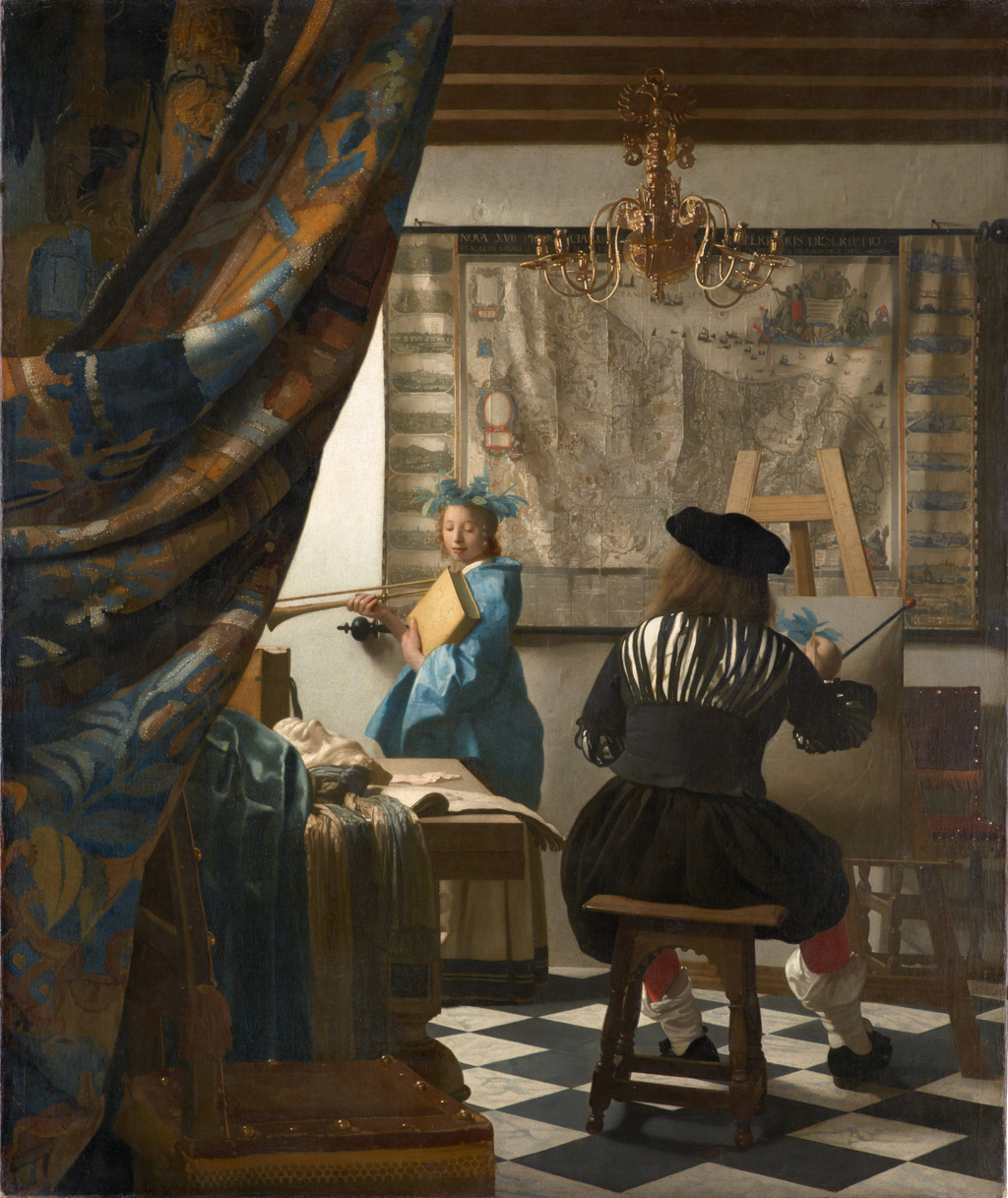
Johannes Vermeer, "The Art of Painting", 1668
Taking place in a more modern setting compared to Kennedy and Welty’s works, Rooney’s Normal People follows the characters of Marianne and Connell as they slowly move into the reality of society. In what could be described as a “coming-of-age” novel, Marianne and Connell exist in different social contexts and are confronted with the question of identity throughout the work. In an effort similar to that of Kennedy and Welty, Rooney engages with the impact of artistic expression with specific reference to the visual, literary, and even musical arts. Connell, who presents as a rather pessimistic character, comes to find deep meaning in writing as the novel progresses. Through his experience at a public book reading, which he initially believed to be pointless and void of purpose, he finds that the process of writing becomes a passion and ultimately reflects best his internal struggle with his identity and the world around him. After arriving home from the book reading, Connell feels inspired to work through ideas of an in-progress creative story, in which he “felt the old beat of pleasure inside his body” (Rooney, 228), similar to that of Yeats’ “fire” that was in Aengus’ head in “The Song of Wandering Aengus” (line 2). In this moment of what one could align with the pure passion that Yeats’ explores, Connell hears from a passing car the lyric of a song that states, “Life offers up these moments of joy despite everything” (Rooney, 228). Despite the despair, tragedy, and trauma that seems to encircle the characters of Rooney’s novel on both a personal and social level, they are able to experience these moments of joy through art and reflection. Perhaps Rooney, too, is suggesting that the experience of personal freedom in which one transcends the harsh reality of time marching forward serves as an act of resistance to the tragedies of the world. In this context, literature is a deeply intimate process of navigating not only one’s personal identity, but moreover coping with the traumas of the world and seeking out the good.
Through artistic expression and collective tradition, the very essence of culture is both explored and celebrated. Though experiences in the American South differ from those in Ireland, there remain intricate similarities in the foundations of these respective cultures and the ways in which their artistic practices have developed over time. Despite the fact that Kennedy and Rooney do not outwardly reference Irish folklore, tradition and inter-community relations often uphold legends of the past. These legends explore the very meaning of life, yet approach dense topics from a personal and individual viewpoint. Particularly, there remains intriguing cultural overlap between Irish and Appalachian customs. While Welty’s text is not set in Appalachia, Appalachian culture upholds the artistic traditions seen across the three respective texts explored throughout the previous sections. Dr. Emily Kader, professor at Appalachia State University, draws conclusions between these two cultures through the artistic expression of ballads, largely pulling from the work of D.K. Wilgus, a 20th-century English professor and folklorist at UCLA. In both Kader and Wilgus’ work, they explore how “oral traditions of southern Appalachia are generally thought to be an American composition in fact derives from the Irish oral tradition” (Kader, 426). Both Kader and Wilgus assert that the ballad of “Rose Connolly” serves as a cultural expression. Moreover, they explore how this ballad was generally unacknowledged as deriving from Irish rather than English culture. Much of Wilgus’ work draws clear parallels between traditional Irish folksongs to ballads of the American south, yet recognizes that the acceptance of Irish culture in Appalachia was few and far between. As Kader suggests, this is largely due to the misinterpretation that the Irish who immigrated to Appalachia were only “post-Famine Catholic” (429). This perspective, in connection with the denial of Irish culture as influence to the South, emphasizes that protestant groups of Irish immigrated with knowledge of traditional Irish ballads, thus weaving the culture of Appalachia with Irish folklore. In her essay, Kader asks that we reframe our perspective of the Irish diaspora and Ireland as a whole, acknowledging the immigration of Irish individuals to Appalachia as being a continuum from the 17th-century onward and not being a journey solely embarked upon by Catholic groups (429). Regarding the content of the ballads, however, similar themes arise across both Irish and southern ballads. Those discovered as having the most similar parallels present themes of tragedy, loss, and death, topics seen scattered throughout the history of both Ireland and the South. As suggested by both Kader, the themes and explorations recounted in these ballads must hold true to the region in which they are expressed, otherwise, they do not become integrated as a part of cultural tradition (436). These ballads are means of grieving for communities. They foster communal mourning, engagement with critical ideas of life itself, and, for Irish immigrants to Appalachia, served as a reminder of home. Ultimately, though Kennedy, Rooney, and Welty’s work does not directly reference folklore or ballads, the sentiment of art as a mediator still exists in Rooney’s work as equally as it is expressed in these ballads. Artistic expression serves as a force that connects cultural communities. Art as means of a culture tradition present as a powerful, revolutionary act that has withstood the test of time.